

In a new study, fixed-dose combination (FDC) of
vildagliptin and dapagliflozin demonstrated substantial
efficacy and good tolerability in managing Type 2 Diabetes Mellitus (T2DM).
The recent study
titled, “DApagliflozin 10 mg and Vildagliptin 100 mg SR use in Cardiology
Practice: A real world Clinical Insight (DAa-ViNCI
Study),” was published in May 2025 in the Medical Research Archives -Journal
of the European Society of Medicine.
The study aimed to
assess the early initiation of vildagliptin
and dapagliflozin FDC’s efficacy, safety, and
tolerability in real-world cardiology practice, with ethical approval obtained.
The study was a retrospective, non-randomized, non-comparative
investigation conducted across 200 cardiology centers in India. It included 2199 T2DM
patients with
a mean age of 55 years. The patients were prescribed the FDC of
vildagliptin 100 mg SR and dapagliflozin 10 mg. Comprehensive patient
information, including demographics, treatment duration, comorbidities, and
adverse events, was gathered.
The study included
T2D patients with high CV risk with a spectrum of about 10 various
cardio-metabolic co-morbidities.
Among the study
participants, hypertension was the most prevalent comorbidity (74.81%),
followed by dyslipidemia (38.52%), coronary artery disease (14.60%),
stroke/transient ischemic attack (5.23%), non-alcoholic fatty liver disease
(4.32%), retinopathy (3.50%), nephropathy (3.14%), foot ulcer (1.50%), erectile
dysfunction (0.73%), peripheral artery disease (0.64%) and others (1.22%).
The following are
the study end points:
– Glycemic endpoints included changes in glycated
hemoglobin (HbA1c), fasting
plasma glucose (FPG), postprandial glucose (PPG), and achievement of glycemic
goals.
– Blood pressure efficacy was evaluated through
changes in mean systolic (SBP) and diastolic (DBP) readings.
Additional
efficacy and safety parameters included quality of life (adherence and absence
of side effects) and adverse events related to FDC therapy in the past year.
The study also
examined FDC usage patterns, including the number and percentage of patients on
FDC across age groups, therapy duration, comorbidity duration, and treatment
compliance.
Key findings from the study are:
Clinical Efficacy
- Glycemic
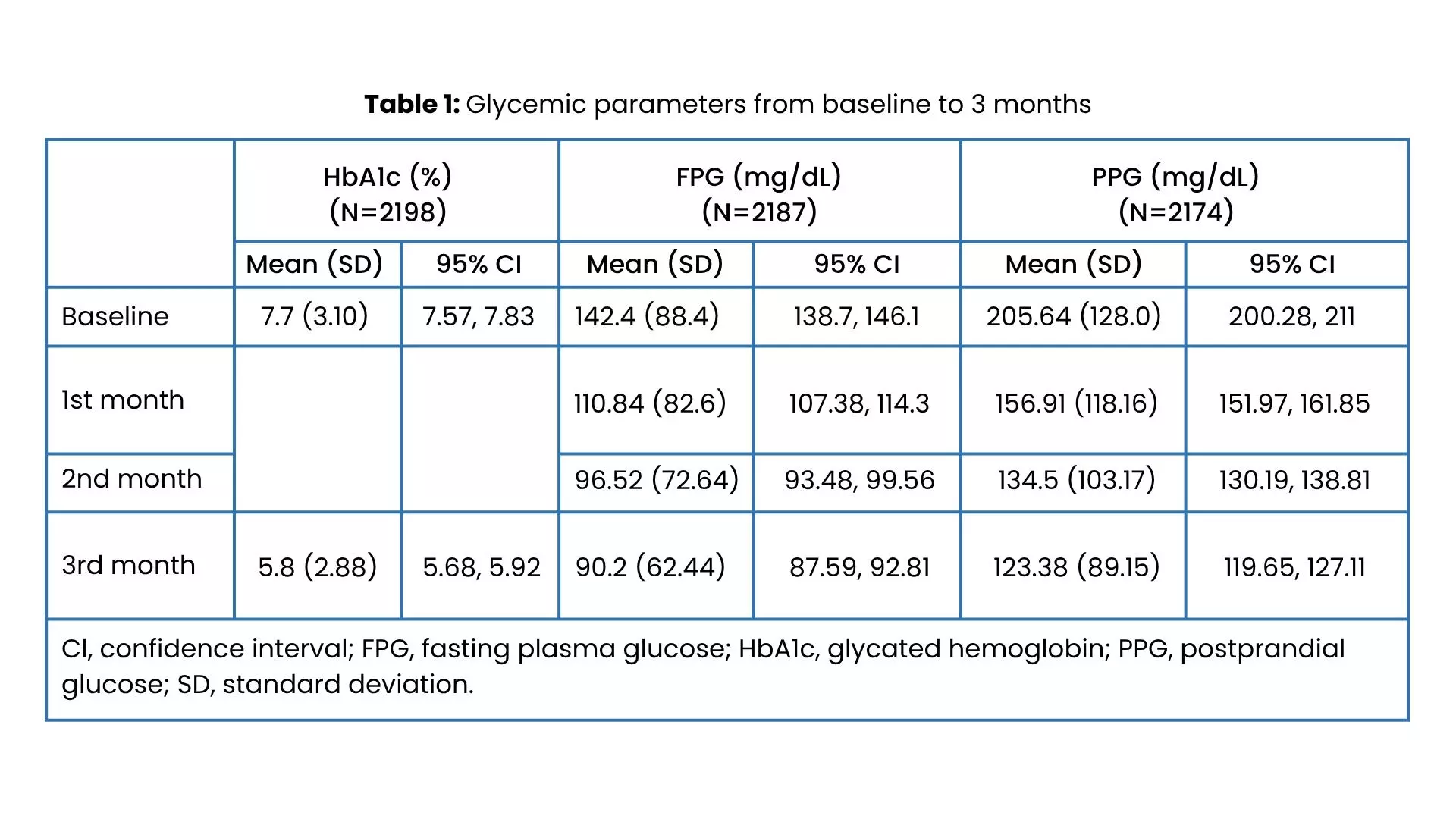
control improved substantially over three months. HbA1c
decreased from 7.7% (SD 3.10) to 5.8%
(SD 2.88) leading to a reduction of 1.9%, fasting plasma glucose (FPG)
dropped from 142.4 mg/dL (SD 88.4) to
90.2 mg/dL (SD 62.44), resulting in a reduction of 52.2mg/dl and postprandial
glucose (PPG) reduced from 205.64 mg/dL
(SD 128) to 123.38 mg/dL (SD 89.15), causing a reduction of 82.3mg/dl at 3
months. (Table 1)
- Out of 2199, 1717 patients (78.08%) achieved
their glycemic goal.
- Mean systolic blood pressure (SBP) reduced from 141.35 mmHg to 131.59 mmHg
resulting in a reduction of 10mmHg, and mean diastolic blood pressure (DBP) dropped from 89.65 mmHg to 84.42 mmHg
leading to a reduction of 5mmHg.
Physician
Assessment, Adherence & Safety
- According
to the physicians’ global assessment, 73.35% of physicians observed good
efficacy. Additionally, 73.81 reported good tolerability of the FDC.
- No
patients discontinued the therapy due to adverse effects, indicating good
tolerability of the combination.
- Adverse events were minimal, reported
in only 0.36% of patients, with urinary tract infection being the most common
at 0.13%.
The DAa-ViNCI Study provides real-world evidence that the
vildagliptin/dapagliflozin FDC is an effective and well-tolerated option for
managing T2DM, particularly in Indian cardiology practice. By significantly
improving glycemic control and lowering blood pressure with a low incidence of
adverse events, the combination supports better cardiovascular health and
overall patient outcomes in routine clinical settings.
T2DM is a major global health
challenge. Patients with T2DM often present with early cardiovascular risk factors
such as hypertension and dyslipidemia, making these patients more prone to
progressive vascular damage.
Effective T2DM management requires
addressing both blood sugar and cardiovascular risks, and the fixed-dose
combination of vildagliptin and dapagliflozin offers a synergistic solution by
improving glycemic control and reducing blood pressure and weight.
The study highlights the clinical importance
of early initiation of Vildagliptin – Dapagliflozin FDC in T2DM patients with
cardiovascular risk, supporting durable
glycemic control as well as cardiovascular risk prevention.
Reference: Kaur, M., Kalra, T., Kumar, M., Bansal, A., Avasthi, A., & Thakur, S. (2025). An In Vitro Study to Examine the Comparative Accuracy and Stability of Elastomeric Impression Materials under Different Levels of Hydration. Dental Journal of Advance Studies, 13(1), 1-7.